
Where to turn: Chapter 3
Say very little, slowly and softly. “I’m here. You’re safe.” Questions and explanations don’t reach them now.
From the book
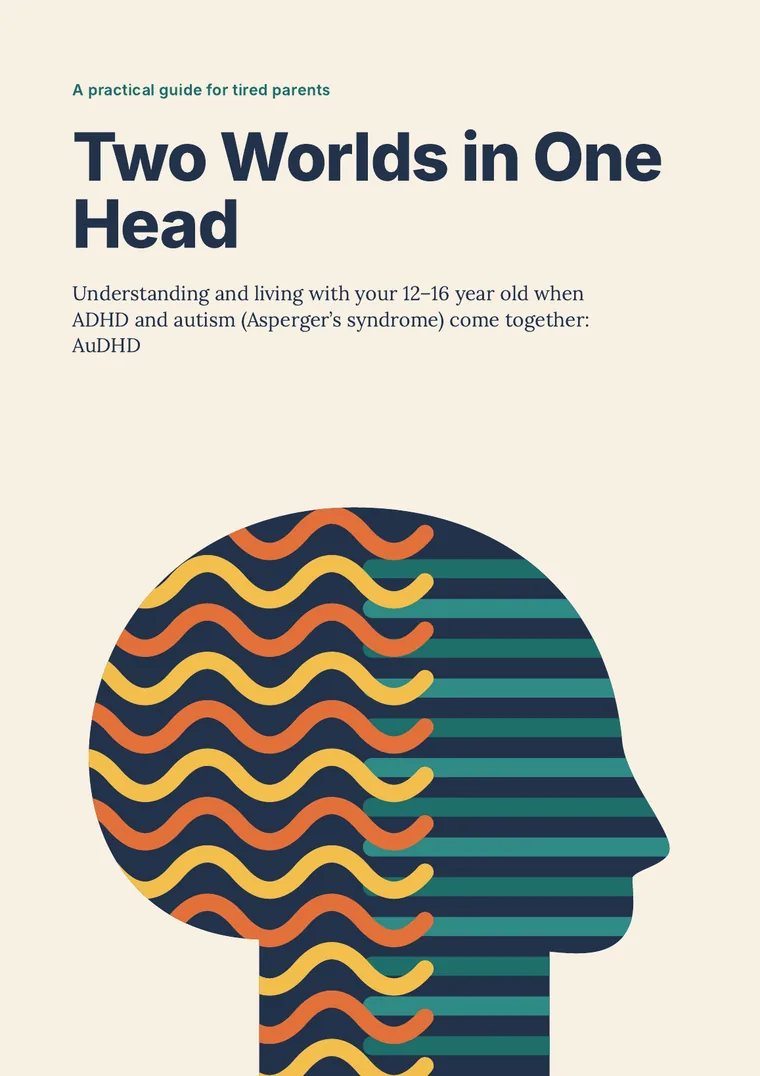
Two Worlds in One Head. A practical guide for tired parents
“How can she spend hours mastering one topic and still not find her shoes?”
One system hunts for novelty, the other for sameness. Both run in the same brain in the same minute. This book explains in plain language what is going on when a 12–16 year old has both ADHD and autism, and what you can try this week.
The PDF arrives by email straight after payment. Secure checkout. 14-day money-back guarantee.
Everything was fine, I asked him to turn off the game, and he exploded.Chapter 3
He’s nearly sixteen and I’m still waking him, reminding him to wash, eat, do homework.Chapter 6
Mornings end in tears and nausea, yet school says she’s quiet and fine.Chapter 7
Every request gets a “no”, even for things he wants himself.Chapter 5
My daughter is a model pupil at school and falls apart at home every day.Chapter 12
Every rule becomes a court case.Chapter 11
These questions come from the book’s chapters. They are composites, paraphrased in our own words from public parent forums. They are not quotations and describe no real person.
Difficult behaviour is usually a sign of difficulty, not a flaw of character. Understanding the reason does not mean giving up limits. It means putting limits and support where they have a chance of working.
That is how many people describe it. It is also why advice written for ADHD alone, or autism alone, so often half works.
Every chapter has three layers: what ADHD adds, what autism adds, and what appears only when both are present. That third layer is often why standard advice fails.
You don’t read this book in order. Choose what is hardest right now to see where to turn and what the book suggests.
Where to turn: Chapter 3
Say very little, slowly and softly. “I’m here. You’re safe.” Questions and explanations don’t reach them now.
From the book
Where to turn: Chapter 5
Keep basket A small. Letting basket C go on purpose frees energy for A and B.
From the book
Where to turn: Chapter 6
A list by the door, photos of items, an audio reminder. When a list reminds, not you, there is less conflict.
From the book
Where to turn: Chapter 6
Shrink the start until it’s almost silly. “Just open the notebook.” Starting is often hardest; continuing is easier.
From the book
Where to turn: Chapter 7
Don’t argue that morning. Find out calmly later.
From the book
Where to turn: Chapter 8
Don’t cut off a game abruptly. Many games can’t be paused.
From the book
Where to turn: Chapter 9
Consider starting with sleep.
From the book
Where to turn: Chapter 10
The goal isn’t popularity. One or two good ties are enough.
From the book
Where to turn: Chapter 11
Start by acknowledging what’s correct. “You’re right, the teacher said Friday. That wasn’t fair.”
From the book
Where to turn: Chapters 12 and 13
Stop the bills. Reduce demands to essentials.
From the book
Where to turn: Chapters 7 and 12
Home is the safest place to fall apart, which is a sign of trust in you.
From the book
Where to turn: Chapter 15
Lower the bar. Dinner from the freezer is fine. A messy house is fine.
From the book
If anyone is in immediate danger, contact your local emergency services at once. This book is not a crisis service.
You asked for the bins to go out and your teen exploded. See what was already in the glass.
What you can change: the level in the glass.
The load glass from Chapter 3. An illustration, not a measurement.
Many chapters include tables like this. Here are a few lines.
| Instead of | Try |
|---|---|
| “How many times do I have to say it?!” | “I see it’s not done. What’s getting in the way of starting?” |
| “Look at me when I’m talking!” | “Look wherever you like. Just tell me what you heard.” |
| “You always have an excuse.” | “Something seems to block the start. What’s the easiest first bit?” |
| “You’re addicted.” | “I’ve noticed it’s hard to sleep after games. What could we change?” |
| “It’s only a small change!” | “I know this wasn’t the plan. What’s the plan B?” |
Short chapters, colour-coded layers, diagrams and numbered steps you can follow even when you are tired.
The quick map: where to turn when you need an answer now
How ADHD and autism collide in daily life
The load glass and the course of a meltdown
Three baskets: limits without war
The staircase back to school
A one-page profile for school and doctors
The sample includes the important notice about the book, the contents, the quick map, and Chapters 1 and 3.
Each chapter has a parent’s question, the three layers, numbered steps, phrases, things to avoid, tips by age, and when to talk to a professional.
A few figures from studies named in the book, so that you can look them up yourself.
A twin study suggests the overlap is partly explained by shared genetic factors, with shared family environment contributing very little (Ghirardi et al., 2019). Environment still matters greatly for how things go, but you did not “raise” these traits.
You don’t have to be a perfect parent. This guide can help you understand what is going on and know what to try next.
€12.90
One payment, no subscription.
Buy the book for €12.90If the book isn’t right for you, email us within 14 days of buying and we’ll refund the full amount. No reason needed.
Straight after payment you receive an email with a link to download the PDF. If you can’t see it, check your spam folder or email us.
Yes. It is a standard PDF that opens on a phone, tablet, computer or any e-reader that supports PDF. The pages are A4, so it is most comfortable on a tablet, a computer or printed out.
No. The book does not diagnose and cannot tell you whether your child has either condition. If your teen has one diagnosis but support helps only partly, you could ask a specialist whether the other should be assessed too. The book focuses on verbally able teenagers without intellectual disability.
It was compiled with artificial intelligence from publicly available sources. No clinician wrote or reviewed it. The opening pages of the book and the free sample say more about this.
No. The book deliberately does not discuss medication and does not recommend any treatment. Please take those questions to a doctor.
If anyone is in immediate danger, contact your local emergency services at once. This book is not a crisis service. You can find crisis lines by country at findahelpline.com.
Email us within 14 days of buying, from the address you used to buy. We refund the full amount. Money usually reaches your account within 5–10 business days.
You pay on the secure Hostinger store checkout, and payments are processed by Stripe. We never see or store your card details.
You can print it for personal use, and the appendices are made for filling in. Please don’t pass the file on to others: it is for the buyer and their family.
Yes. Email us with the address you bought from and your billing details.